Inflation
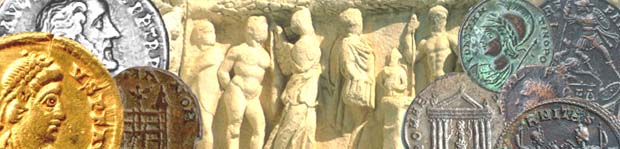
During the Republic, money used for commerce was made of quite pure silver. Cast copper ingots and later, cast coins were used by the local populace. The Empire had a regular currency struck in gold. silver, brass, copper, and various alloys of bronze and billon. During the early Empire the struck silver coins (denarius and antoninianus) were quite pure. During Nero's reign (54-68 A.D.) the percentage of silver dropped to 90%. During the reign of Trajan (98-117) it dropped to 85%. By the time of Septimius Severus (193-211) it was only 50-60%. Runaway inflation occurred during the reign of Gallienus (253-268) and the "silver" antoninianus started out at 40% silver, 60% copper and wound up only 5% silver. The gold maintained its purity until late Byzantine times, but fluctuated in weight. The Roman mints, each with several officinae, or workshops, were a mass-production concern that produced an estimated 1 million coins per day at certain peak periods, Today, many ancient Roman coins in good condition, and even some gold are quite common and available.
In A. D. 305, Emperor Diocletian proclaimed a law that put a ceiling on wages and prices. It didn't have any more success than any other such law in history, including even one in the USA during the 1970's.
Return to The Roman Economy Table of Contents
The Ancients' First Use of Money
What are the Functions of Money?
Some Different Economic Systems in History
Inflation